7 things nobody warned you about perimenopause.
Number 3 is the one most women get wrong — including a lot of doctors.
76% purchase intent in Walmart consumer research · Hormone-free · Third-party tested
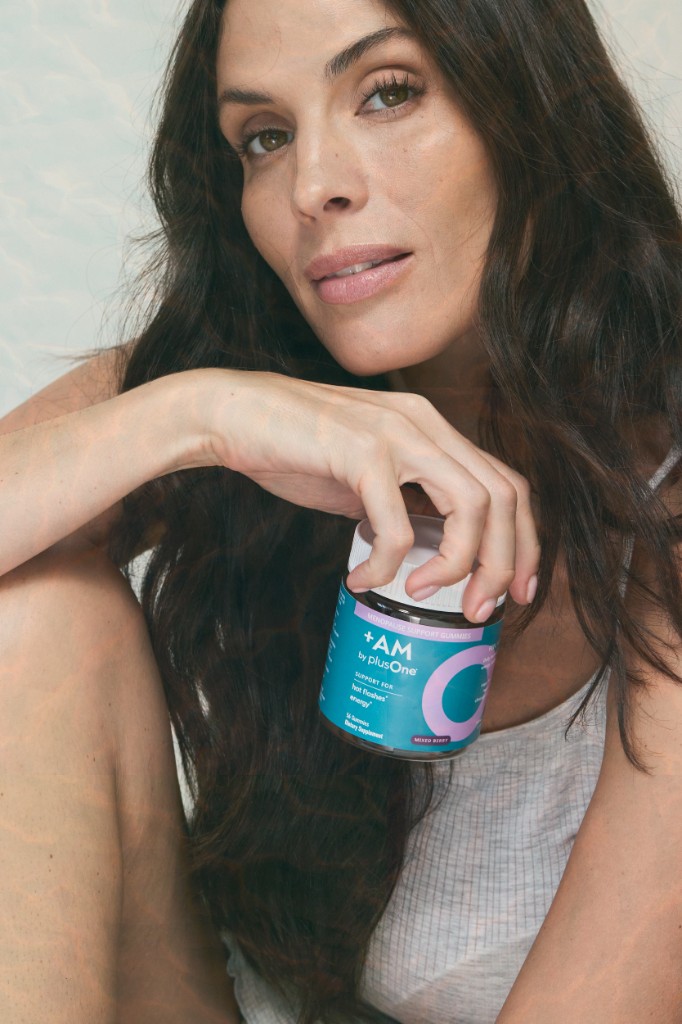
You're 43. You haven't slept properly in months. You cried at a cereal commercial. You walked into the kitchen and forgot why, three times, before 10 a.m.
You went to your doctor. She ran a blood test, said everything looked normal, and asked if you'd been under a lot of stress lately.
Here's what's actually going on.
It starts far earlier than anyone tells you.
The number you've heard is 51. That's the average age of a woman's final period — the finish line, not the starting gun.
The transition leading up to it commonly begins in the early-to-mid 40s, and for some women in their late 30s. Which means by the time anyone says the word “menopause” to you, you may have been in it for the better part of a decade.
Nobody tells you this. So when it starts, you assume it's something else.
There's no test that can tell you.
This is the part that makes women feel crazy.
Hormone levels during this transition don't decline in a neat line — they swing, sometimes dramatically, day to day. An FSH test on a Tuesday can look completely normal and mean nothing at all.
So you get the blood work back, it says “normal,” and you're left holding a list of symptoms with no explanation attached. A normal test result is not evidence that nothing is happening.
It's not mostly about hot flashes.
Ask anyone what menopause is and they'll say hot flashes. Ask women what's actually bothering them and you get a very different list.
In the largest analysis of its kind — 321 studies, 482,067 women — hot flashes weren't at the top of the list. Joint and muscle discomfort and physical exhaustion both ranked higher.
BMC Public Health, 2024. Global pooled prevalence.
Most women never connect the sore shoulder or the foggy afternoon to the same underlying change. They just think they're getting old, fast.
The 3 a.m. wake-up is a symptom.
Not a personality trait. Not “just how you sleep now.”
More than half of midlife women report disrupted sleep (Mayo Clinic Proceedings, 2025), and it's rarely trouble falling asleep — it's waking in the small hours, wide awake, sometimes hot, sometimes with your heart going, and lying there until five.
And here's the compounding problem: almost everything else on this list gets worse when you're not sleeping. The mood. The fog. The patience. Sleep isn't one symptom among fifteen. It's the one that makes the other fourteen harder.
This is not a bad few months.
The largest US study to follow women through this transition found that frequent hot flashes and night sweats last a median of 7.4 years.
For women whose symptoms started before their periods stopped, it was 11.8 years. For Black women in the study, a median of 10.1 years.
SWAN, JAMA Internal Medicine, 2015
Seven and a half years is not something you white-knuckle through. It's a period of your life. It deserves an actual plan.
Your doctor probably wasn't taught this.
This isn't a knock on your doctor. It's a knock on how they were trained.
In a study of medical residents across 20 programs, only 6.8% felt adequately prepared to manage menopause. (Mayo Clinic Proceedings, 2019)
A more recent survey of OB/GYN residency program directors found fewer than a third said menopause education was included in their curriculum, and 71% reported two or fewer lectures on it per year.
So when you're told you're too young, or that it's stress, or that your labs are fine — that's usually not dismissiveness. It's a gap in the training. But it lands on you either way, and it's why so many women spend years assuming they're the problem.
Daytime and nighttime are different problems.
This is the one that changed how we built our product.
The things bothering you at 2 p.m. and the things bothering you at 2 a.m. come from the same underlying change — but they are not the same problem, and they don't respond to the same things.
Daytime is energy, focus, mood, staying comfortable through a meeting. Nighttime is winding down, staying cool, staying asleep.
Almost every menopause supplement on the shelf is a single bottle you take once a day. That never sat right with us.
So we built two.
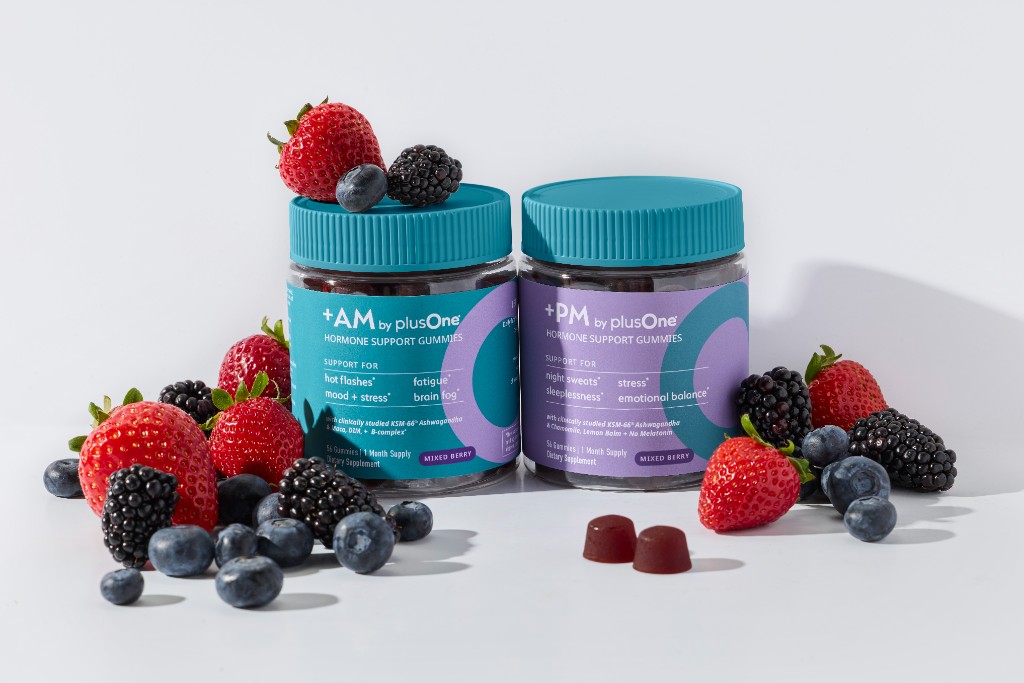
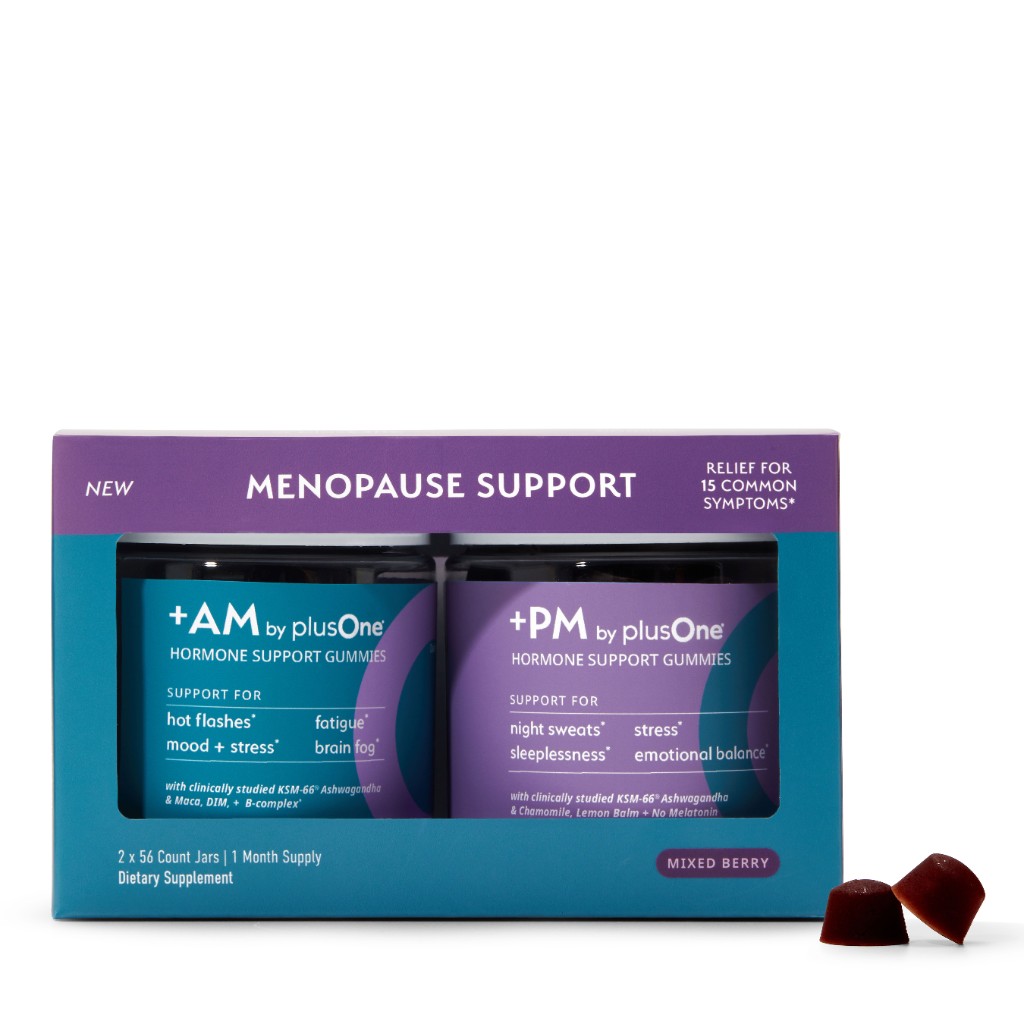
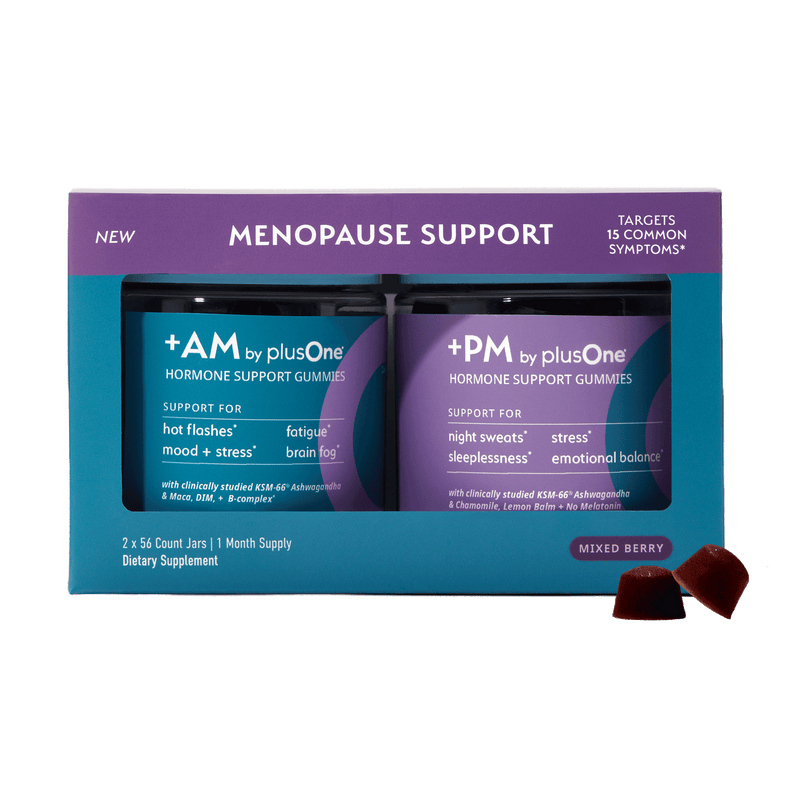
plusOne 24-Hour Menopause Support is two formulas in one routine. Sugar-free. Hormone-free. Vegan. Third-party tested. Nothing to swallow.
Inside: KSM-66® Ashwagandha, DIM, maca, chasteberry, green tea, vitamin K2 and B vitamins.
Inside: Chamomile, lemon balm, rhubarb root and KSM-66® Ashwagandha — a branded, standardized extract, with the dose on the label.
We asked. They answered.
We took the concept to Walmart shoppers and asked a simple question.
said they would buy the 24-hour menopause gummy system
Walmart shopper research, before launch
said they would buy +libido, our intimacy gummy
Walmart shopper research, before launch
Real shoppers, a real question, and a real answer — before a single jar had shipped.
This is a supplement, not a medicine.
It won't replace talking to a doctor, and if something on your list is severe, please go talk to one. It won't work in three days. It isn't a hormone and it won't act like one. It won't do the same thing for every woman on the list, because nothing does.
What it will do is give you two moments in your day where you're doing something about this — and twelve weeks to decide whether it's worth keeping.
Start your 24-hour system.
Two formulas, morning and night. Free +libido with your first subscription, free shipping, and 120 days to decide.
Ships same day
Pause, skip or cancel in one click. No phone call, no email, no retention flow.
The one thing nobody puts in their cart.
women with these symptoms don't discuss them with a healthcare professional.
StatPearls / NIH
+libido Daily Intimacy Gummies — free with your first subscription. A $19.99 value. No note on the box.
Days. Keep the bottles.
Take the full 120. If it isn't doing anything for you, email us and we'll refund you. No return shipping. No explanation needed.
The ones people actually ask.
I'm 41. Is this for me?
I'm 58 and past all this. Is this still for me?
How long until I notice anything?
Is this hormones?
Can I pause or cancel?
You're not imagining it. And you're not alone.
Start My 24-Hour SystemFree +libido with your first order · 120 days · Cancel anytime
* These statements have not been evaluated by the Food and Drug Administration. This product is not intended to diagnose, treat, cure, or prevent any disease. KSM-66® is a registered trademark of Ixoreal Biomed. S7® is a registered trademark of VDF FutureCeuticals, Inc. Consult your healthcare provider before beginning any supplement, particularly if you are pregnant, nursing, or taking medication. Individual results vary.